


Is the ventilation you aim for the ventilation your patient receives? While ventilation is a fundamental component of cardiopulmonary resuscitation (CPR), recent evidence suggests a troubling gap between clinical intent and delivered ventilation. New data reveals that even with advanced airway in place and mechanical ventilators, the “intended” tidal volume often fails to reach the lungs.
In this article, we dive into the latest insights from an editorial by J.Wittig and K.G Lauridsen (1), discussing the results from Eickelmann et al. (2) and exploring why monitoring ventilation is becoming a clinical necessity. From the significant leakage differences between Endotracheal Tubes (ETT) and Supraglottic Airways (SGA) to the hidden variability of manual bagging, we break down what you need to know to optimize ventilation quality during CPR.
When ventilator settings do not reflect delivered ventilation
ETT vs SGA ventilation quality
The editorial analyzes findings from a cohort study comparing ventilation delivery in patients with out-of-hospital cardiac arrest who received advanced airway management and continuous mechanical ventilation during continuous chest compressions.
Investigators compared ventilation delivered through endotracheal tubes (ETT) and supraglottic airway devices (SGA). The objective was to measure the discrepancy between the tidal volume programmed on the machine and the actual delivered volume measured at expiration. By quantifying the leakage percentage and the expired tidal volume, the study aimed to determine if ventilator settings alone are a reliable indicator of patient ventilation during the high-pressure environment of CPR.
The results
Despite similar ventilator settings in both groups, the delivered ventilation differed significantly.
Patients ventilated through an endotracheal tube received substantially higher expiratory tidal volumes than those ventilated with a supraglottic airway. Leakage was also substantially different, averaging around 5% with ETT compared with more than 40% with SGA.
These findings suggest that the choice of airway device can significantly influence the ventilation quality during CPR.
Even mechanical ventilation does not guarantee accurate delivery
One of the most striking observations highlighted in the editorial is the large deviation between the tidal volume set on the ventilator and the tidal volume actually delivered, even when ventilation was provided by a mechanical ventilator and through an endotracheal tube.
During CPR, ventilation is influenced by multiple factors including
- chest compressions,
- airway seal and leakage,
- airway pressures generated during ventilation,
- and the complex interaction between ventilation and chest compressions.
Together, these factors can significantly alter airflow and tidal volume delivery.
In other words, even when ventilation parameters are precisely set on a mechanical ventilator, the volume reaching the patient’s lungs may be very different from what is intended.
What does this mean for manual ventilation?
While the study analyzed mechanical ventilation, the implications extend well beyond ventilator use.
In many prehospital and emergency settings, ventilation during CPR is still delivered manually using a bag-valve mask or through advanced airways. Manual ventilation introduces additional sources of variability, including operator technique.
If discrepancies between intended and delivered ventilation occur even under controlled mechanical ventilation, it is reasonable to assume that manual ventilation may be even more variable during resuscitation, as highlighted by the team of the Paris Fire Brigade (3) in their 2025 OHCA study.
This reinforces the editorial’s central message: ventilation during CPR should be actively monitored.
From recommendation to clinical practice
International resuscitation guidelines already emphasize the importance of monitoring ventilation performance during CPR. However, in routine clinical practice, ventilation quality is rarely measured objectively.
Without monitoring, clinicians cannot easily detect problems such as insufficient tidal volume delivery, excessive leakage, and hyperventilation or hypoventilation.
This creates a critical gap between guideline recommendations and real-world practice.
Measuring what matters
The editorial ultimately strengthens the growing call within the resuscitation community to measure intra-arrest ventilation.
Objective monitoring allows clinicians to verify whether ventilation targets are being achieved and to adjust their technique accordingly.
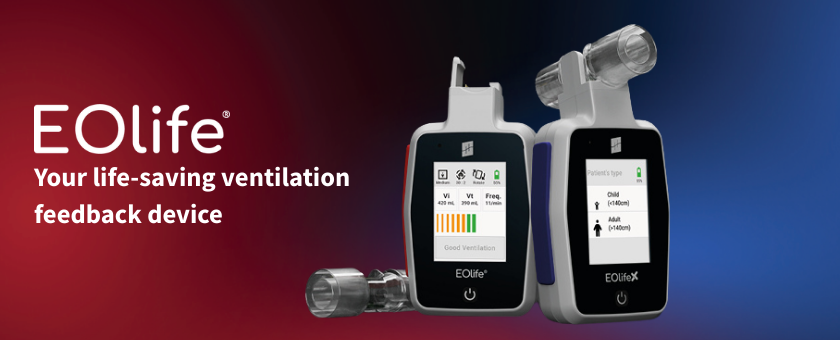
This is precisely the role of ventilation feedback devices (VFDs) such as EOlife.
By tidal volume, leakage and ventilation rate in real time during manual ventilation, EOlife enables clinicians to monitor ventilation performance continuously during CPR, helping ensure that the ventilation delivered to the patient aligns with guideline recommendations.
GET IN TOUCH
Schedule a demo
You might also like
(1) Wittig J, Lauridsen KG. Examining asynchronous intra-arrest ventilation through the prism of advanced airway devices – are all our tools equal?. Resuscitation. 2026;219:110958. doi:10.1016/j.resuscitation.2026.110958
(2) Eickelmann C, Beiske AJ, Deicke M, et al. Tracheal intubation vs. supraglottic airway devices during mechanical intra-arrest-ventilation with volume-controlled-ventilation in out-of-hospital cardiac arrest: a cohort study. Resuscitation. 2026;219:110918. doi:10.1016/j.resuscitation.2025.110918
(3) Lemoine F, Jost D, Lemoine S, et al. Manual bag-valve-mask ventilation during out-of-hospital cardiopulmonary resuscitation: a prospective observational study. Resuscitation. 2025;217:110895. doi:10.1016/j.resuscitation.2025.110895