

Mechanical chest compression devices are now widely used by EMS teams during cardiac arrest resuscitation. Devices such as the LUCAS 3 (Stryker), the Corpuls CPR, or the AutoPulse (Zoll) are now considered standard equipment in many life support systems. Once applied to the patient, these devices automatically deliver chest compressions via a moving piston. This frees providers to focus on other critical tasks like airway management or drug administration.
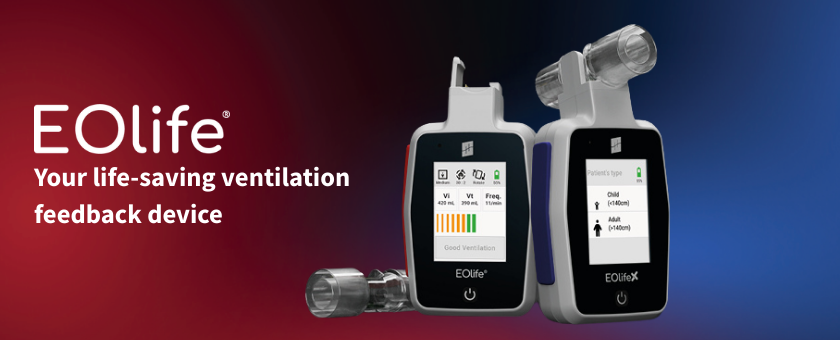
But a question remains: can EOlife, the real-time ventilation feedback device, be used effectively alongside these mechanical CPR devices?
The short answer is yes, and EOlife becomes even more valuable in this context. Here is why.
Ventilation during continuous chest compression
In continuous chest compression mode, compressions are delivered without pausing, at a target rate of 100 to 120 per minute. Ventilation is performed independently (asynchronously), at a rate of approximately 10 breaths per minute.
The challenge: compressions and airway pressure interact
As the piston moves downward during the compression phase, it compresses the thorax and increases intrathoracic pressure. If a ventilation breath is delivered during this downstroke, the pressures are additive. As a result, this can cause dangerously elevated airway pressures, reduced tidal volume delivery, and increased risk of gastric insufflation or barotrauma. Providers may face these risks while having no real-time visibility into what is reaching the lungs.
How EOlife helps
EOlife connects directly to the BVM circuit and measures ventilatory parameters breath-by-breath, in real time. During continuous compressions with a LUCAS 3 or AutoPulse device, EOlife allows providers to:
- Verify that each delivered breath reaches the target tidal volume (typically 500mL to 600 mL in cardiac arrest)
- Detect inadequate ventilation caused by compression-related pressure spikes
This real-time feedback loop is not available with standard BVM ventilation. Moreover, its importance is increased when mechanical compressions are running simultaneously.
30:2 ventilation with mechanical CPR: the pause duration challenge
In 30:2 mode, the mechanical CPR device automatically pauses compressions after each set of 30. This creates a brief window for the provider to deliver two rescue ventilations. While this mode is less commonly used in current cardiac arrest protocols with intubated patients, it remains in use in specific protocols. It is also used for non-advanced airway management situations.
The default pause problem
On most mechanical CPR devices, the factory default pause duration in 30:2 mode is set to 3 seconds. In practice, delivering two effective ventilations within 3 seconds is extremely difficult, particularly under the stress of an ongoing resuscitation.
The LUCAS 3 advantage
On the LUCAS 3 (Stryker), the pause duration in 30:2 mode is adjustable and can be extended to up to 5 seconds. This additional time meaningfully improves the ability to deliver two proper insufflations. When combined with EOlife, providers can use this extended pause to:
- Deliver two ventilations and confirm adequate tidal volume for each breath in real time
- Detect mask leaks or airway obstruction immediately, before compressions resume
We recommend checking the pause duration settings on your mechanical CPR device before deployment and extend it to the maximum allowed value when using the 30:2 protocol.
Conclusion: better compressions deserve better ventilation
Mechanical CPR devices like the LUCAS 3 have transformed the quality and consistency of chest compressions during out-of-hospital cardiac arrest. But compressions are only half of the resuscitation equation. Ventilation quality during CPR remains highly variable, difficult to assess, and often suboptimal.
EOlife closes this gap. By providing real-time, breath-by-breath feedback on tidal volume and ventilation rate, it extends the benefit of precision to the ventilation side of resuscitation. This applies regardless of whether you are running continuous compressions or 30:2 cycles.
If your team uses a LUCAS 3, Corpuls CPR, or AutoPulse device, EOlife is a natural and clinically meaningful addition to your resuscitation protocol.
Want to learn more? Contact us to discuss how EOlife integrates into your current EMS workflow, or visit our website for clinical data, training resources, and compatibility guides.