


In the high-stakes environment of a pediatric intensive care unit (PICU), Bag-valve-mask (BVM) is performed in nearly all intubation procedures. Despite its routine use, the quality of BVM ventilation is rarely assessed using objective metrics. Instead, clinicians rely on indirect clinical signs, such as chest rise, oxygen saturation, or end-tidal CO2, to gauge success.
However, a recent observational study published in Pediatric Critical Care Medicine suggests a startling reality: nearly 80% of manual breaths delivered to critically ill children fail to meet quality standards.
This new objective evidence highlights a critical gap between perceived performance and the ventilation actually delivered in daily clinical practice.
| Key takeaways The perception-reality gap: While clinicians often believe BVM ventilation is successful in 90% of cases, objective data reveals that 78% of manual breaths delivered in the PICU actually fail to meet quality standards. The age factor: The risk is highest for our smallest patients; 85% of breaths delivered to infants (<1 year) are suboptimal, significantly increasing the technical difficulty for smaller anatomies. Direct impact on safety: Poor ventilation quality isn’t just a technicality—it is associated with a 2.8-fold increase in adverse airway events, such as severe oxygen desaturation and intubation complications. The need of feedback: Traditional “visual” assessment is insufficient. We must transition to real-time, objective feedback training that allows clinicians to see—and correct—tidal volume and mask leaks as they happen. |
> Watch the video
Interested in EOlife Ventilation Feedback devices?

A study designed to objectively measure ventilation quality
Between 2019 and 2022, this single-center observational study (1) tracked 8,446 breaths across 85 pediatric patients in PICU settings. The goal was to address this gap by directly measuring the quality of BVM ventilation delivered to pediatric patients prior to intubation.
Using a respiratory function monitor placed between the mask and the ventilation device, investigators were able to capture continuous flow and pressure measurements, allowing precise calculation of tidal volumes, airway pressures, and mask leak on a breath-by-breath basis.
To ensure the results reflected real-world habits, clinicians were “blinded” to the data.
Ventilation quality was assessed using predefined criteria. A breath was considered low-quality if it involved inadequate or excessive tidal volume, excessive airway pressure, significant mask leak, or failure to overcome upper airway obstruction. At the patient level, ventilation was classified as globally low-quality when the majority of breaths met at least one of these criteria.
And the results of the study are striking.
Data doesn’t lie: 78% of low-quality breaths
The majority of ventilation delivered in this cohort did not meet quality standards. Overall, 78% of all breaths were classified as low-quality. At the patient level, two-thirds of children received predominantly low-quality ventilation during the pre-intubation phase.
The most common issues identified were:
- Inappropriate tidal volumes (either insufficient or excessive),
- Significant mask leak,
- Excessive airway pressures to a lesser extent.
These findings indicate that maintaining appropriate ventilation parameters during manual ventilation is considerably more difficult than generally assumed.
Small patients, big risks
The study also highlights a strong age-related effect. Infants (<1 year) and young children (1-7 years) were significantly more likely to receive low-quality ventilation compared to older children.
In these younger populations, the proportion of low-quality breaths reached approximately 85%, with higher rates of excessive tidal volumes, greater mask leak, and more frequent exposure to elevated airway pressures.
This suggests that the technical challenges of pediatric ventilation increase as patient size decreases,reducing the margin for error and making precise control of ventilation even more critical.
Poor ventilation quality, associated with worse outcomes
The study found that, after adjustment for respiratory pathology, low-quality ventilation was associated with a 2.8-fold increase in the risk of adverse airway events.
It means that when BVM ventilation quality is poor, children are nearly three times more likely to suffer from:
- severe oxygen desaturation
- complications related to tracheal intubation.
BVM ventilation quality is not simply a technical consideration, but a direct determinant of patient safety during airway management.
A major gap between perception and reality
One of the most important insights from this study lies in the gap between what clinicians think they are doing and what is actually happening. Previous reports, based on clinician assessment, have suggested that difficult or inadequate BVM ventilation occurs in less than 10% of cases. In contrast, this study shows that suboptimal ventilation is the rule, not the exception. Nearly 80% of breaths may be suboptimal when evaluated using objective criteria.This gap highlights a fundamental limitation of current practice: clinicians do not have access to reliable, real-time indicators of ventilation quality. As a result, both under-ventilation and over-ventilation may go undetected, despite their potential harmful effects.
Implications for training and clinical practice
These findings call for a reassessment of how BVM is taught and performed, particularly in pediatric settings. Traditional training methods, largely based on visual assessment and subjective feedback, may not be sufficient to ensure consistent delivery of appropriate ventilation.
Improving performance requires a shift toward measurable and reproducible targets, supported by objective data. This is particularly important in pediatrics, where variability in patient size and physiology increases the complexity of ventilation.
Bridging the gap: the role of real-time feedback
The study makes a compelling case for a paradigm shift: we must move from subjective “feel” to objective, measurable data.
By giving clinicians access to key indicators such as tidal volume, ventilation rate, and mask leak, these approaches enable a more precise understanding of what constitutes effective or ineffective ventilation. They make it possible to identify errors that would otherwise remain undetected when relying solely on clinical signs.
While this study focused on the PICU, these challenges are also encountered in emergency settings, including cardiopulmonary resuscitation (CPR), where conditions are often even more demanding.
In this context, training becomes a critical lever for improvement. However, traditional training methods do not allow clinicians to objectively assess the quality of the ventilation they deliver, limiting their ability to correct and refine their technique.
By providing real-time feedback on ventilation parameters during simulation and CPR training, ventilation feedback devices enable clinicians to visualize the impact of their actions, better understand target ranges, and develop more consistent and controlled ventilation practices.
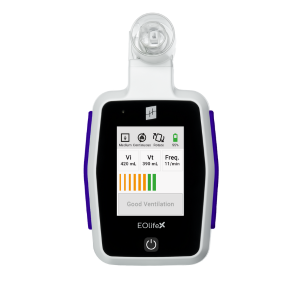
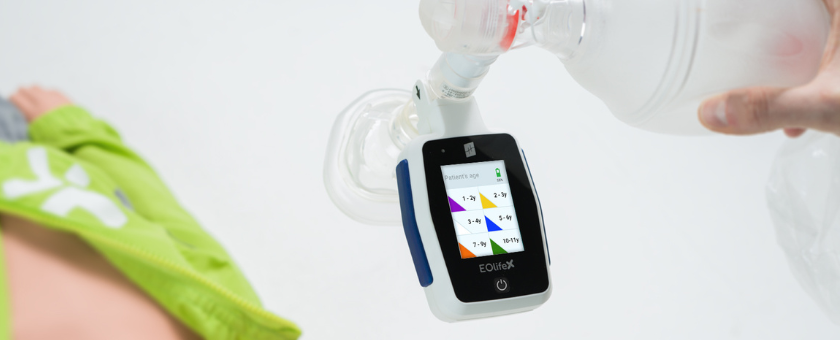
EOlife X, the ultimate tool for high-performance ventilation training.
Training tool allowing calculation and recording of insufflated volume, tidal volume, manual ventilation frequency, in real time, to practice ventilation in accordance with ERC and AHA recommandations. EOlife X enables training on adult and pediatric (>1 year) manikins.
By translating objective evidence from clinical studies into measurable training targets, such approaches contribute to bridging the gap between observed performance in real-life settings and expected standards of care.
Conclusion: making the invisible, visible
The study provides a reality check for pediatric care: even in controlled environments like the PICU, manual ventilation is frequently suboptimal, and its quality has a direct impact on patient outcomes.
By highlighting the high prevalence of inadequate ventilation and the limitations of subjective clinical assessment, it reveals a critical gap between perceived performance and actual practice. Importantly, it shows that key determinants of ventilation quality—such as tidal volume, airway pressure, and mask leak—remain largely invisible to clinicians during routine care.
While conducted outside the context of cardiac arrest, these findings have broader implications. They underline that the challenges of manual ventilation are inherent to the technique itself and are likely to be even more pronounced in high-stress situations such as resuscitation.
Addressing this gap requires more than awareness. It calls for a shift toward objective, feedback-driven approaches to training, enabling clinicians to better understand, measure, and control ventilation performance.
Bridging the gap between evidence and practice is essential to improving both the quality of care delivered at the bedside and the effectiveness of training in critical situations.
To learn more about how EOlife X can enhance your training protocols,
Request a demo today
You might also like
(1) Shepard LN, Napolitano N, Dominick C, Nickel AJ, Shults J, McGovern EL, Bruins BB, O’Halloran A, Huh J, Topjian A, Kirschen MP, Morgan RW, Sutton RM, Nadkarni VM, Nishisaki A. Quality of bag-mask ventilation for children before intubation: single-center PICU pilot observational study, 2019–2022. Pediatr Crit Care Med. 2026. doi:10.1097/PCC.0000000000003925