

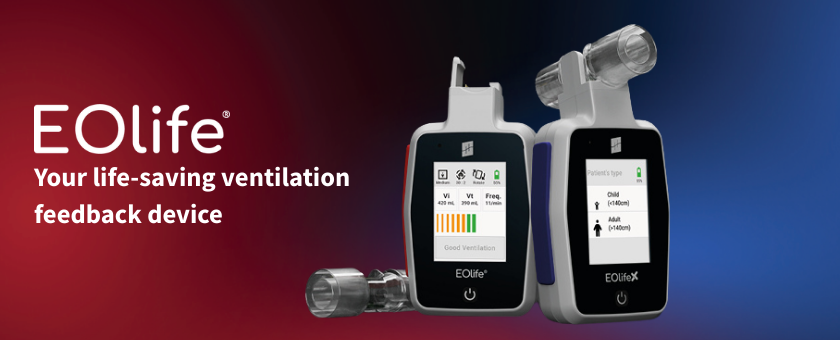
In the event of a sudden cardiac arrest (SCA), every second counts and every action must be measured. While chest compressions have seen decades of innovation, the use of Bag Valve Mask ventilation has remained largely unchanged, unmeasured and uncontrolled. The introduction of Ventilation Feedback Devices (VFD), such as EOlife, is changing the game by offering precision where guesswork once ruled.
1) Without VFD, manual ventilation performance is generally poor
Clinical evidence shows that without real-time monitoring, ventilation quality remains dangerously low, even among professional responders.
Reality in the field
A 2024 study conducted by the Paris Fire Brigade (BSPP)1 revealed a staggering 41% mask leak rate during CPR when EOlife monitoring was not visible to the rescuers.
- The findings: Out of 106 OHCA (Out-of-Hospital Cardiac Arrest) patients, the median tidal volume was only 291 mL—well below international guidelines.
- The shocking truth: 80% of tidal volumes were under 400 mL, and only 16.9% of ventilations complied with international recommendations.
Reality in training
Even in controlled environments, the results are concerning. A 2024 study using EOlife X in “blind mode” (feedback hidden) revealed that only 5% of ACLS training participants ventilated correctly2. This proves that certification alone does not guarantee physiological accuracy without objective feedback.
2) Manual resuscitators alone are not enough
A common misconception is that the bag itself can ensure safety. However, recent results presented by Bob Page proves otherwise.
In a comparative study between various devices—including the Sotair Safe BVM, Pulmodyne VT Select, and a standard Ambu SPUR II as a control group—the findings were clear: regardless of the ventilation device used, ventilation without feedback rarely complies with guidelines3. The human factor (stress, fatigue, and lack of sensory reference) makes it nearly impossible to deliver consistent volumes. Only real-time feedback enables consistent adherence to life-saving guidelines.
3) VFD’s impact on survival and patient outcomes
The ultimate goal of CPR is not just a beating heart, but a functioning brain. A recent study published as a thesis showed EOlife triples the chances of survival with good neurological outcomes4.
The study compared 48 patients treated with EOlife against 118 patients ventilated without it.
The results demonstrate a massive shift in patient outcomes:
- Survival rates: The rate of survivors without neurological sequelae jumped from 3.39% (without EOlife) to 10.42% (with EOlife).
- Quality of survival: remarkably, 100% of the survivors in the EOlife group suffered no neurological damage.
By preventing hypo/hyper ventilation, the VFD ensures that “saving a life” means returning a patient to their family with their cognitive faculties intact.
Request a demo today
1) Lemoine F, Jost D, Lemoine S, et al. Manual bag-valve-mask ventilation during out-of-hospital cardiopulmonary resuscitation: a prospective observational study. Resuscitation. Published online November 12, 2025. doi:10.1016/j.resuscitation.2025.110895*
2) D’Agostino, F., et al. (2024). Are Instructors Correctly Gauging Ventilation Competence Acquired by Manual Ventilation Trainees? Resuscitation, 185, 110240.
3) https://www.jems.com/patient-care/making-the-case-for-high-performance-ventilation/
4) Da Cunha, Marie. (2025). Use of a manual ventilation assistance device for the management of out-of-hospital cardiac arrest by firefighters in Doubs, a real-world study. DOI:10.13140/RG.2.2.25073.54884