

Mask leakage as a major determinant of ventilation quality: insights from the Paris Fire Brigade Prospective Study
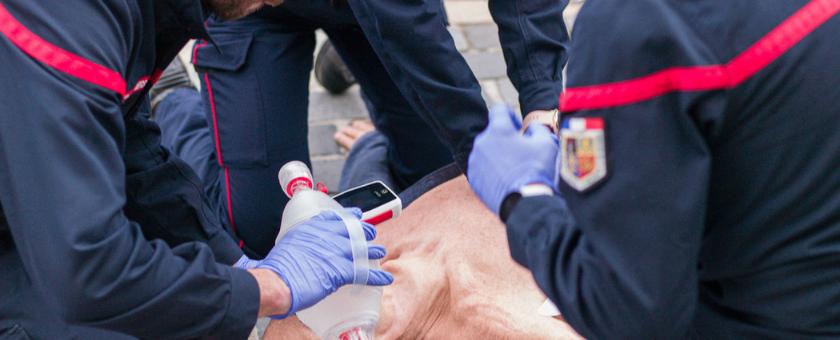
The Paris Fire Brigade used the EOlife device in blinded mode to objectively assess manual ventilation quality during adult out-of-hospital cardiac arrest (OHCA). All included patients were ventilated with a bag-valve-mask (BVM) using the 30:2 approach.
This initiative generated one of the most comprehensive datasets to date on real-world ventilation performance. It revealed that patients were frequently hypoventilated and that mask leakage played a central role in compromising tidal volume delivery.
A prospective observational study in a high-performance Fire & Rescue system
The findings were reported in a recent Resuscitation publication [1] by the Paris Fire Brigade research team. The study was conducted within a highly experienced EMS system performing approximately 4,500 OHCAs annually. All cases were managed by professional firefighters trained in standardized resuscitation techniques. Ventilation is predominantly delivered using a one-person BVM method. However, a two-person technique is implemented when additional personnel are available.
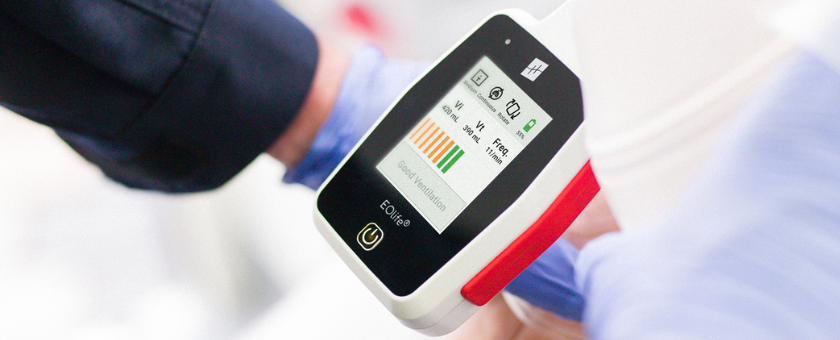
In 2023, 27 emergency vehicles were equipped with EOlife devices, configured to record ventilation metrics without providing feedback to rescuers. Recorded parameters included insufflated volume, tidal volume (accounting for leakage), leakage volume and ratio, and ventilation rate.
Over a five-month period, 106 adult OHCA patients were enrolled (median age 74 years; 61.5% male).
High prevalence of leakage and suboptimal delivered tidal Volumes
The study revealed a major mismatch between what rescuers tried to deliver and what patients actually received. Although rescuers insufflated about 525–531mL per breath (1st breath – 2nd breath), the delivered tidal volumes were only 273–327 mL, meaning that roughly half of each breath never reached the lungs.
This missing volume corresponds to 170–222 mL of leakage per breath, showing that a substantial portion of every insufflation escaped around the mask or in the stomach instead of entering the airway.
Guideline adherence was also very limited.
- Only 16.9% of breaths reached internationally recommended tidal volumes — in other words, more than 4 out of 5 breaths were not conform with the guidelines.
- Nearly 80% of ventilations fell below the 400 mL minimum threshold, confirming that insufficient ventilation was the norm rather than the exception.
Thus, a large proportion of each rescue breath was lost due to mask leakage.
Introducing a two-person technique provided only limited improvement: leakage decreased by about 50 mL, but this reduction was not enough to deliver consistent, guideline-compliant tidal volumes.
Overall, the authors underline how inherently difficult it is to maintain a proper mask seal during CPR. Achieving adequate ventilation requires perfect coordination of mask positioning, hand pressure, bag squeezing, and timing — tasks that are interdependent and performed under significant physical and cognitive stress. This complexity explains why ventilation quality remains so variable and often inadequate
Implications for clinical practice : the role of ventilation feedback devices
The study clearly demonstrates that manual BVM ventilation, when performed without objective monitoring, suffers from inherent and largely unrecognized limitations—even within a highly trained EMS system. As with any complex clinical task, performance cannot be improved if it is not measured, and the absence of real-time information prevents rescuers from detecting excessive leakage or insufficient tidal volumes as they occur.
Ventilation Feedback Devices such as EOlife address this gap by continuously monitoring the quality of each breath and providing immediate feedback on tidal volume delivery and mask leakage. This real-time visibility acts as a “co-pilot” during ventilation, enabling providers to recognize when technique is deteriorating and to perform timely corrections.
By guiding rescuers toward consistent, guideline-compliant ventilation, EOlife offers a practical and evidence-informed pathway to mitigate the technical challenges highlighted in the Paris Fire Brigade study and to elevate the overall quality of manual ventilation during resuscitation.
Conclusion
This prospective observational study provides robust real-world evidence that mask leakage and inadequate tidal volume delivery are prevalent during manual BVM ventilation in OHCA, even within a high-performing fire & rescue system. The findings underscore the challenges inherent to maintaining an effective mask seal and delivering guideline-complient ventilation under the demanding conditions of cardiac arrest care.
Ventilation Feedback Devices, as EOlife, represent a pragmatic and evidence-informed strategy to improve ventilation accuracy, reduce leakage, and enhance adherence to resuscitation guidelines.
Their integration into EMS practice will contribute to more consistent ventilation performance and, ultimately, better-quality resuscitation efforts.
Are you interested in EOlife to improve your ventilation quality ?
Learn more
Reference :
[1] Lemoine F, Jost D, Lemoine S, et al. Manual bag-valve-mask ventilation during out-of-hospital cardiopulmonary resuscitation: a prospective observational study. Resuscitation. Published online November 12, 2025. doi:10.1016/j.resuscitation.2025.110895*